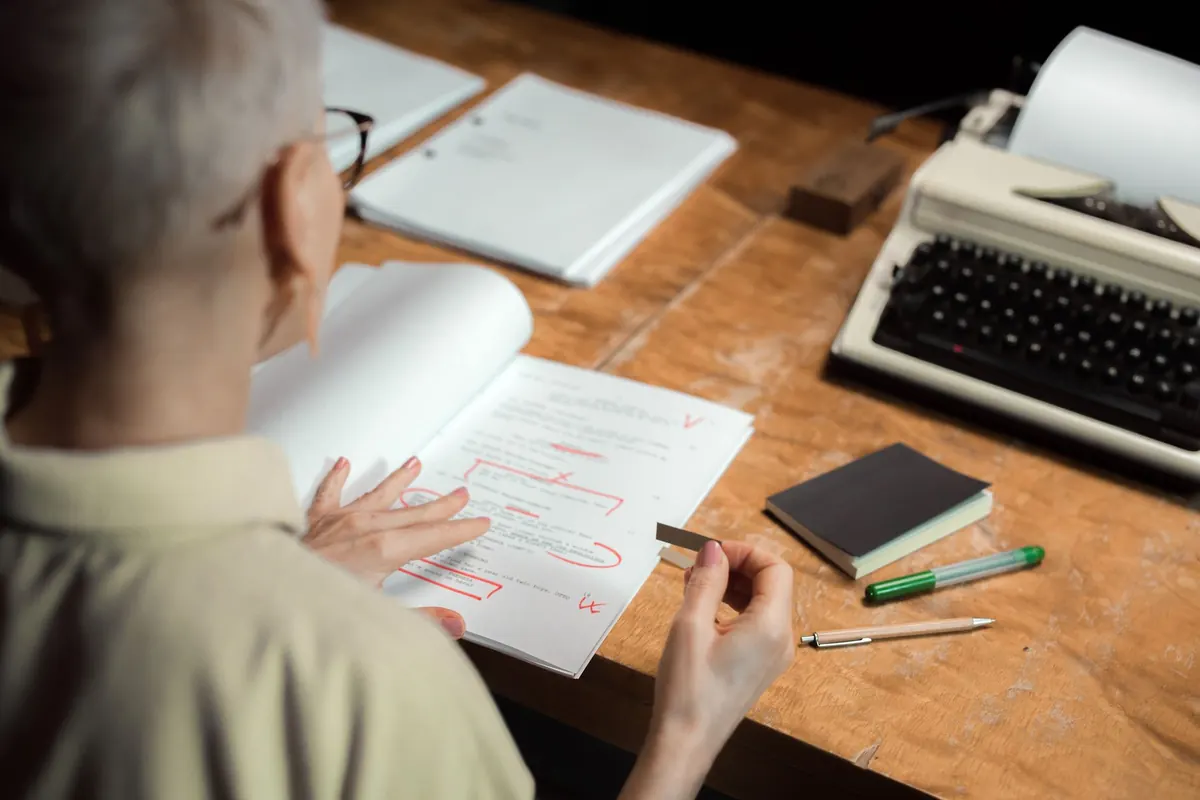
You have typed the last sentence of your first novel. The hard part of writing it is over; the work of making it readable is just beginning. What sits in your document now is a very long draft that contains a good book somewhere inside it, and the job ahead is not writing but deciding: what stays, what moves, what goes. Most beginners try to make all those decisions at once, worrying about a comma on page 41 while a plot hole yawns open on page 40. After three weeks of nudging, they have a manuscript that has been touched everywhere and improved nowhere. The remedy is to work in passes, each with one job, done in a fixed order.
Why Four Passes Beat One Long Fix
Editing feels like a single activity. It is at least four, and they interfere with each other. Reading for structure requires you to skim and hold forty chapters loosely in your head, noticing that the antagonist disappears for a hundred pages. Reading for typos requires the opposite: slowing to a crawl, sometimes a single sentence at a time. Do both together and you do neither well, because the closeness needed to catch a missing word pulls your attention away from the shape of the whole.
So run four passes, in this order, because each one changes the text that the next one reads. There is no sense polishing sentences in a scene you are about to delete.
- Structure pass: does the story hold together from the first page to the last?
- Scene pass: does every chapter earn the space it takes up?
- Sentence pass: does the prose sound like you, only cleaner and quicker?
- Proofreading pass: are any errors left?
Leave a gap between passes. A week is good, three days will do. You need to come back slightly strange to your own book, the way a reader will meet it.
Pass One: Structure
Before you change a word, make a map. Write one sentence per chapter on a separate sheet: who wants what, what goes wrong, what has changed by the end. If you cannot summarise a chapter in a sentence, that is your first finding. It may be doing no work at all.
Then ask the large questions, in this order. What does the protagonist want, concretely, by the end of chapter three? What stands in the way, and does that obstacle get harder rather than softer? Does the middle of the book raise the stakes, or does it repeat the same argument with different furniture? Does the final chapter resolve the promise the opening made, or does it resolve a different, smaller story? Is anything happening to the character, or only around them?
Fix the shape before you fix the prose: move scenes, merge two thin chapters into one strong one, cut the confident opening that explains everything. Resist rewriting dialogue here. If a line bothers you, note it in the margin and keep moving; you will meet it again in pass three with better information.
Pass Two: Scenes
Now go chapter by chapter and put each scene under the same four questions: whose scene is it, what do they want when it begins, what is in their way, and what has changed when it ends? A scene that changes nothing is not a scene. Cut it, or fold its useful material into the one before.
- Enter late, leave early. Start after the greetings, end before the character has finished processing. Readers do not need the goodbye at the door.
- Give the scene a turn. Something should be different by the last line: an alliance, a suspicion, a decision, a wound.
- Cut the information delivery. If two characters are explaining the world to each other, ask who benefits and why now. If nobody does, let the reader learn it from a fight instead.
- Add the reaction beat. After something large happens, give the point-of-view character a moment to absorb it before the next event lands.
- Check the ground. Where are we, what time is it, who is in the room? One clean orienting line at the top saves readers from floating.
This is also the pass for point of view. Pick the character who has the most to lose in each scene and stay in their head; head-hopping mid-scene is one of the most common faults in a first novel.
Pass Three: Sentences
Only now do you read for language, and you read out loud where you can. Your ear catches what your eye forgives.
Cut the filters
New writers put a pane of glass between the reader and the action: she saw that the window was open, he felt his stomach tighten, she noticed a letter on the table. Remove the glass. The window was open. His stomach tightened. A letter lay on the table. The point of view is already doing the seeing.
Strengthen the verbs
Adverbs are usually a sign that the verb is tired. He walked quickly to the car becomes He hurried to the car. She said angrily becomes She snapped, or better, a line of dialogue that snaps by itself. Hedging words, the seemed to and began to of a cautious draft, can nearly always go.
Vary the rhythm
Three long sentences followed by a short one make the short one land. Read a paragraph aloud and listen for the flat, even tread of identical lengths. Break some. Join others with a semicolon or a dash. End paragraphs on the strongest word rather than the newest idea.
Listen to the dialogue
People interrupt, dodge and answer the question they wish had been asked. Cut the logistics: no reader needs a full exchange about ordering coffee unless the order matters. Replace he asked with nothing when the line is clear, and let characters misunderstand each other now and then, as they do in life.
Pass Four: Proofreading
This is a different kind of reading: slow, suspicious and mechanical. Change the format to break your familiarity, print it if you can, and read paragraphs in reverse order so you see words rather than meaning. Read the dialogue aloud in a flat voice.
Keep a style sheet as you go, a single page listing the facts you must not contradict:
- Names and spellings, including the minor characters you invented in chapter six and renamed in chapter twenty.
- Physical details: eye colour, cars, houses, injuries that heal too fast.
- The timeline, including days of the week, seasons and how long the journey actually takes.
- Your own verbal tics, which you can now hunt with the search function: just, very, suddenly, slightly, a little.
A spellchecker will not catch the homophones, so check its and it's, their and there, lead and led by eye. Standardise your formatting: chapter headings, the spacing between scenes, the way you punctuate thoughts.
Working the Method Without Losing Your Nerve
Set a session limit and stick to it. An hour of structural reading is worth more than four hours of queasy scrolling. Finish one pass completely before starting the next, and keep a notebook beside you for anything that belongs to a later pass; that note is how you stop yourself from editing a comma while the plot is still broken.
Between pass two and pass three, hand the manuscript to one trusted reader and ask two specific questions: where did you get bored, and where did you get confused. Their answers are data, not a verdict. Then make your own decisions.
Finally, know when to stop. When a full pass turns up nothing but matters of taste, you are done. Somewhere around the third or fourth pass, the corrections get smaller and the book gets quieter, and that is the sound of it being ready.
Photo: Ron Lach / Pexels